Adored

“Who do you think she was?”

Marie was photographing the spiraling volutes of a broken column. She straightened to look back at Tess, then joined her before the enormous sculpted head resting on the ground. “She’s lovely.”

Tess nodded, dark curls bouncing. “It’s her eyes. She looks like she’s surprised she’s being worshipped.”

“The guidebook says this temple was dedicated to a goddess named—”

“Not the goddess,” Tess interrupted. She took a step forward, leaned across the velvet rope and rested a hand on the statue’s forehead. “Her.”

“The . . . model?” Marie stammered. She started flipping through her guidebook, though she knew it would be useless. “I don’t . . . I’m not sure,” she trailed off. Tess wasn’t really expecting an answer anyway. Marie felt a familiar heartache, wishing that her friend’s expression of wonder might be directed at her instead of a statue.

“Who were you looking at?” Tess asked the marble.

“You,” Marie whispered. “It’s always been you.”

Tess turned sharply, “Did you—”

“I—I wasn’t . . .”

But in that brief moment, with Marie’s guard down, Tess had glimpsed love. It filled her: radiant, expansive, beautiful. She gasped. Anyone looking at Tess at that moment might have believed they witnessed the divine.

* * *

Photo by Jiannis Tsiliakis on Unsplash

Story by Gregory M. Fox

Cave

I
I’ve found a cave I can use for shelter. It’s dry and surprisingly warm, and I’m alone here. There’s enough light to write at the moment, but darkness is coming. I’ll make a fire soon. Maybe tomorrow I’ll move on.

II
Yesterday wasn’t my first day here, but it was the first day I wrote something down.  I think it’s been a couple weeks now. I didn’t think it would be this long.

V
This journal was a dumb idea. I have nothing to say.

VI
I should leave. I can’t stay here forever.

VIII
Something came into the cave today. It stayed at the entrance, but I think it knew I was here. I’m not sure what it was. I was too afraid to move. But what if it was a person? 

XI
It was back today. I called out this time, but there was no response. I’m sure something was in the cave though, even if there were no footprints outside.

XVII
It comes into the cave every night.  It might be in here right now. I should leave.

XXV
It’s waiting for me. The dark. It is the dark. The end. It won’t let me go.

Photo by Alessio Zaccaria on Unsplash 

Story by Gregory M. Fox

Fart

They were together at the table, just finishing their meal when it happened. “What the—” Andrew started. “Did you just . . . fart?”

“What . . . ?” Sara replied still looking at her food. “I—maybe. Yeah, I guess so.” She stabbed fiercely at the last baby corn in her stir fry. “Everyone farts. Why are you making such a big deal about it?”

“Because until today,” Andrew said, “you had never farted in front of me.”

Cheeks flushed, still avoiding eye contact, Sara said. “You’re being gross, and super awkward. It was just a fart. Can’t you let it go?”

Andrew shook his head slowly, deliberately. “I will never let it go.”

“Fine,” Sara shouted, slamming her fork down on the table. “Sorry for ruining our relationship with my flatulence. I guess you’ll just have to dump me and keep looking for that fairy tale woman with no bodily functions to date.” She pushed away from the table, but Andrew grabbed her hand.

“Wait,” he said. “You don’t understand.”

“Don’t understand what?” Looking at him for the first time, she saw his eyes wide, brow furrowed, jaws tense. “What is that face?”

Pthhhppuuuurbbbbt, he farted. “I love you too.”

“You’re disgusting,” Sara said smiling.

Photo by Ishan @seefromthesky on Unsplash

Story by Gregory M. Fox

Cold

It’s cold.

‘Course it’s cold, what’s the point of even commenting on something like that? It’s colder than usual though. And usually I’m not walking around in it. But he took my spot.

So now I’m cold. Cold and scared.

No, I’m not scared. It’s not worth it to be scared. Only thing to be is moving. Keep moving. Just gotta make it to the bridge, then I can rest. It’s dry under there, and no wind.  Not as good as my spot, but better than nothing.

Where’d that guy come from anyway? Never seen him around. He shouldn’t have taken my spot. It was the best spot, especially when it’s this cold. Can’t fight. No sense in fighting a guy like that. No more spot. And I can’t go back to the tents. No more tents either. Just the cold.

Snow’s starting again. Headlights coming fast.  There they go. Almost to the bridge. Lots of folks know the bridge, but maybe some of them are inside tonight. Maybe I’ll be able to stay there. Just for a bit. Then I’ll keep moving.

It’s getting colder. But I’m not afraid anymore. I’m not moving anymore either. When did I stop?

* * *

Photo by Aditya Vyas on Unsplash

Story by Gregory M. Fox

Clinging

“I can’t do this anymore.”

We were used to shouting at each other. Angry clashes and passionate reconciliation had always been our pattern, but then a simple, calm statement ended everything. I couldn’t even summon a response, just stared blankly, searching her face for some sort of explanation.

She shook her head. “Things were supposed to be different here.” I could hear a deep, searing pain in her voice. “You said they would be different.”

“I thought they were.”

She didn’t respond for a long time, just stood in the doorway. Finally she said, “My sister’s downstairs. She’ll give me a ride. The apartment is yours now.” A pause. “Goodbye.”

She must have shut the door, but I did not, could not watch her go. At some point, night fell.

At some point, I smashed a lamp and toppled a bookshelf. At some point, I ran out of liquor. “This is your fault,” I said at last.

A thin voice replied, “No.”

“We left everything to get away from you. You weren’t supposed to be here.”

“You . . .” the voice creaked, “brought me.”

“Leave me alone,” I pleaded.

“I . . . can’t.” And I sat in the darkness, clinging fiercely to my anger.

Photo by Engin Akyurt from Pexels

Story by Gregory M. Fox

Reasons

“Can we talk?”

Leah turned to see Marci on the next stool. “I’d rather not,” she answered flatly and turned away.

“This is uncomfortable for me too,” Marci said, “but we have to talk about this.”

“About how you broke his heart?”

It was what Marci had expected, but it still made her cheeks burn with shame. “Well,” she offered, “if I hadn’t, you never would have gotten together.”

However, Leah’s next reply was entirely unexpected. “We’re not together,” she said, draining the amber liquid from her glass.

“I thought . . .”

Leah turned back, tears glistening in her eyes. “I don’t think he was ever really that interested. Anyway, he’s engaged now or something.”

“Oh,” Marci answered. A pause. “Me too.”

Leah let out a heavy, pained sigh. “Congratulations, I guess.”

The women sat silently in the noisy bar until Marci decided to make one last effort. “You know there’s a reason I left him, right?  There are . . . a lot of reasons.”

“Yeah,” Leah said, “He’s toxic. I get it.”

“If you get it, then why do you still hate me?”

Leah shook her head. “Like you said, if you hadn’t left him, he never would have gotten to hurt me.”

Photo by Austris Augusts on Unsplash

Story by Gregory M. Fox

Radiance

Saul spotted the faint shape in the shadows. “It’s time,” a voice whispered.

“I know,” Saul answered. “I feel weary. Life here has been hard.”

The shape was clarifying. A head tilted. “Then why cling to this life so fiercely?”

Saul sighed. “It’s been too long since you were among people. You’ve forgotten what they’re like.”

There was a face now, frowning. “I’ve watched them interact with you. Small petty things, easily wounded and readily cruel.”

“You misunderstand.”

“Do I? Have they not been cruel to you?”

Saul coughed. “They are brittle, yes. And their broken edges cut deep. But there is more to them.”

“What?”

Saul looked from the shadowy figure beside him to his family gathered around his hospital bed and now beginning to fade. “Light. They are vessels for it, carrying it inside and shining it into the darkness. Even the broken catch it, glinting radiance like shards of glass. To see a spark of curiosity, to hear music suffused with brilliance, to feel the warmth of a kind touch, these are why I cling to life. Their real tragedy is that they are all so desperate for it, rarely realizing how much they have to give.”

Photo by Jakob Owens on Unsplash

Story by Gregory M. Fox

Bronze

eye-384512_1920.jpg

Thomas found his name carved into a brass plate.

“Thomas Porter?” Maya asked. “Why didn’t you tell me there was a monument to you in this park?”

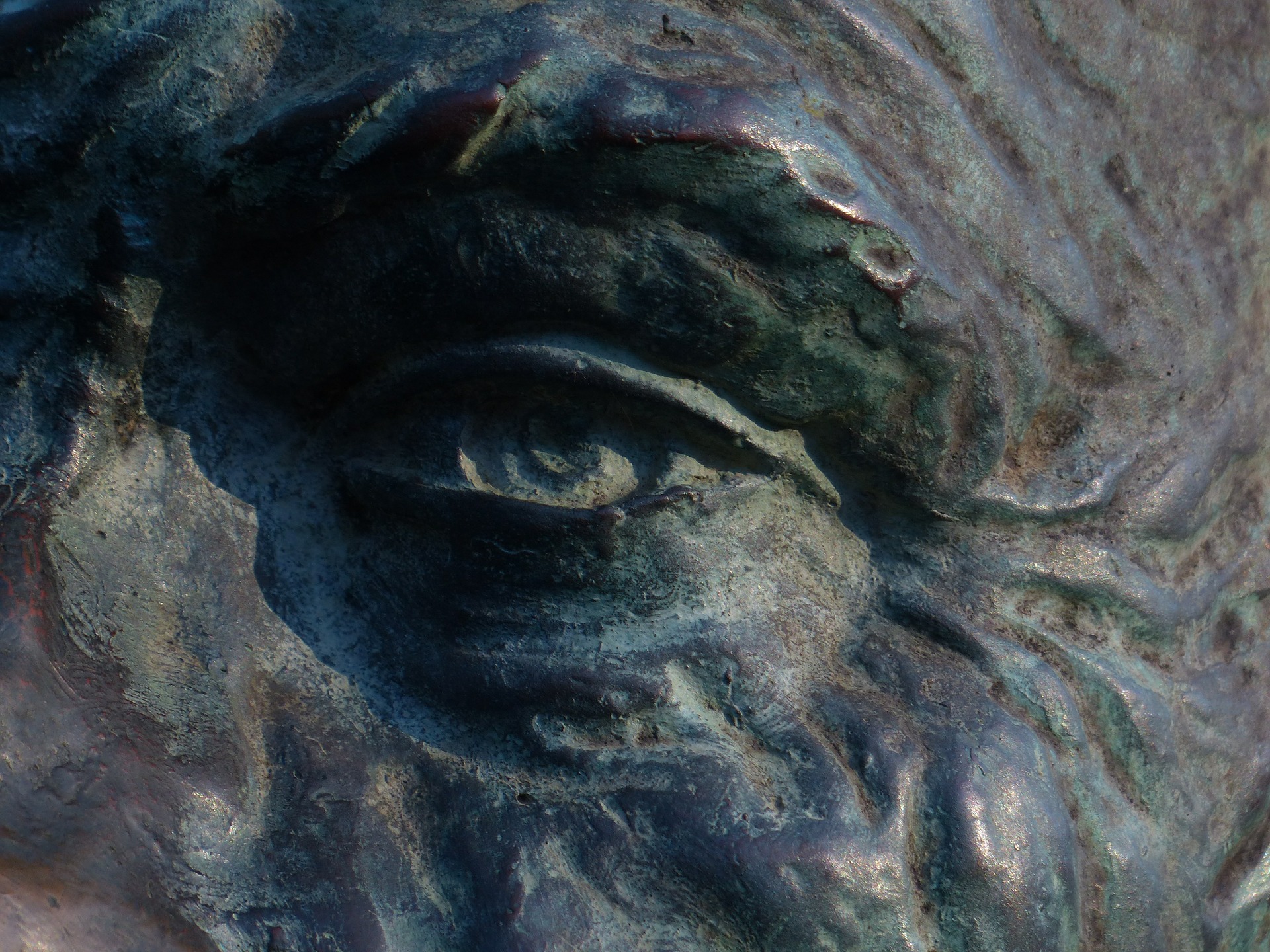
The bronze figure stood slightly larger than life in a classical contrapposto, arm extended magnanimously out to the city. A straight, sharp nose, thin lips smiling beneath a curling mustache.

“I try to keep a low profile,” Thomas joked, “that’s why I told them to use a white guy for the statue.”

“And you were city treasurer almost 200 years ago,” Maya said continuing to inspect the monument. “Didn’t know I was dating such a big-shot.”

Thomas just shrugged and continued walking. There was something unnerving about how the statue with his name on it looked down at them.

Maya spent the rest of their walk looking up what the internet could reveal about the other Thomas Porter: an oil painting in the state portrait museum, some mentions in the city’s history, and a “Historical Porter Plantation” just outside of town.

Thomas feigned disinterest, but he couldn’t shake the image of the other Thomas Porter’s imperious smile as he remembered how some slaves were given their masters’ surname to mark them as property.

*     *     *

Image by Hans Braxmeier from Pixabay 

Story by Gregory M. Fox

Fatherhood

“You know sometimes I wonder if I’m really a good dad,” Mo said pensively.

Beside him, Mo’s best friend, Tug, scratched his belly and asked, “What’s that supposed to mean?”

Down on the grassy plain below them a horde of youngsters tumbled, hooted, and howled. “What, you mean you never worry if you’re doing the best by your kids?” Mo said. “Setting a good example, preparing them for the future, all that?”

Tug gave a long lazy yawn. “Guess I never really thought too much about it that way. I mean they’ve got food, right? They’ve got shelter.  What more’s a father supposed to do?”

“That’s what I’m trying to figure out. I mean, what if being a really good dad isn’t so much about the big things like food and shelter; what if it’s the little things like making them laugh while you pick the bugs out of their fur or showing them how to get the best distance when they throw their feces?”

Tug paused in the midst of picking his nose. “You pick the bugs out of your kid’s fur yourself?” he asked the other chimpanzee.

“Of course,” Mo answered.

“Wow. You really are a good dad.”

Story by Gregory M. Fox

Dread (and Hope)

Part I

She waited.

She checked her phone. No missed calls; no new messages.

She watched the news until she couldn’t anymore.  All those faces. All that pain. Strangers who seemed all too familiar but who still couldn’t answer the question she really cared about.

She checked her phone. Nothing.

It got dark early. Severe, dense clouds looked down from the sky, ready to burst like the multitudes marching through the city streets. Watching the sky was as bad as watching the news. The dread, she realized, was inside her so it manifested in whatever she looked at: folded newspapers, cracked paint, sun-faded family photos.

She checked her phone. No calls. No messages.

Fear. Rage. Futility.

She hurled the phone across the room, and before it had even struck the wall, she let out one sharp, agonized sob.

She waited.

No one was coming to check on her; no one would help pick her up. Finally, she rose, retrieved her phone, screen now cracked, and turned the news back on.

Smoke. Scattered figures running. A flash from something off screen. Shouts and screams. A stammering newscaster. It was starting to rain.

Her phone rang. Emblazoned in the cracked glass, her son’s name.

*     *     *

Part II

“Here they come.”

The plaza had been slowly filling for hours, but now a tidal wave of protesters poured in from main street. He reached under the visor of his riot helmet to wipe the sweat gathered on his forehead.

“Hold this line,” the captain behind him growled.  There were already reports in of property destruction from some of the fringes of the demonstration and the direct command was to put an end to the hostile presence as soon as possible.

So many faces.  So much anger.

Distant thunder.

“Disperse!”

Fingers on triggers. Clouds of gas billowed. People shrieked, ran, fell.

He never saw the brick coming.

His world spun. The surrounding noise rose and fell like crashing waves. Rough stone rushed toward him from above and he lifted his arms to defend himself, gradually realizing he’d fallen to the ground. He lifted his eyes toward heaven.  All was dark and blurry, but his vision was no longer swimming. Raindrops spattered the visor of his helmet.

A single thought: he wanted to feel the rain. His helmet fell to the ground and he looked up into a concerned face. The black man extended a hand, offering support. He took it.

*     *     *

Part III

“We should go,” he said, speaking so low behind his facemask that she could barely hear him above the surrounding crowds.

“What?”

He leaned closer. “We should go.”

Monica’s face twisted in shock and confusion. “What are you talking about? We’re only halfway to the statehouse”

He jerked his head in the direction of two brash, strutting men nearby, both carrying a brick in either hand. “I don’t want to be around if this is going to get ugly.”

“Hey!”

“Monica, don’t—”

Hey, brickheads,” she shouted, drawing eyes all around them, including those of the nearby men. “Yeah you,” she continued.  “You best drop those before any cops see you. We don’t need nobody starting shit today.”

But the men just laughed. “Shit’s gonna go down anyway once the cops start shooting.  Might as well be ready for it.”

“They’re gonna ruin everything,” he said. “We should go.”

She faced him with a dark scowl. “I’m done with living in fear and letting people with hate in they hearts run my life. We gotta hope, or else they win.”

The crowd surged on, billowing and charged like the dark clouds above, and he moved forward as part of it.

*     *     *

Part IV

“I’m trying to get out of here, but I don’t know how.”

It was chaos. He’d seen people with upraised hands being pepper sprayed, cars burning, rubber bullets striking fleeing protesters.

“I’m trying, mom,” he said. “I’m trying to come home. I love you.”

Hanging up, he peeked out from between the cars that sheltered him. Groups were fleeing down First Street unimpeded. Walls of police blockaded every other road out of the plaza. He started running.

Shouts. Smashing glass. Out of the corner of his eye, he saw a lone police officer crumple after being struck by a brick.

He slowed.

No more fear, he thought. No more hate.

He turned and ran to the injured man’s side. Confused, grateful eyes looked up at him. The man took his hand and rose. “Thank you,” the officer rasped.

Then he was plummeting. The ground slammed into his back, and two helmeted officers stood over him menacingly. He opened his mouth to speak, but then his eyes were burning. With a scream, he turned away from the pepper spray and tried to crawl, but clubs striking his back sent him back to the ground.

Wet asphalt.

Cold handcuffs.

Deep, deep pain.

*     *     *

Part V

A mother waits. Her son has not come home, and there have been no more calls.

A mayor reads the tweets of protesters while the evening news plays in the background. There’s a press conference tomorrow, but how can he possibly justify what’s happening? And what will they say if he backs down now?

An officer sits in his squad car outside the station.  He should go home and recover from the day’s trauma. He should not go to sleep due to his minor concussion. He should say something. He should not rock the boat. He should protect his fellow officers. He should protect the innocent. He should have ignored his orders. He should do something. But what?

A young woman clutches the hands of strangers and tries not to cry. In a darkened room, they wait for the National Guard to move through the neighborhood. The elderly man who opened his home to protesters shuffles among them, handing out water bottles, tissues, encouragement.

The most powerful man in the world rages against what he cannot control.

A young man with cracked ribs and red eyes leans his head against the wall of his jail cell and tries to hope.

*     *     *

Hope: an Epilogue

He was quiet, and she was worried. “You don’t have to come today.”

“And waste this sign?” he said, shocked. “Are you kidding?”

She studied him, trying to figure out if he was really as confident as he acted. She could see dry scabs on his hands and his chin and knew that there were deep bruises all over his back. He was still moving a bit slowly, a bit stiffly, and he would wince whenever he took a deep breath. The protest was marching to the statehouse again today. The same place the police had given him those injuries.

“I’m just saying, no one would blame you if you were scared about—”

A gentle smile made her pause. Such a warm, unexpected expression. He stepped close, taking her hands in his. “I’m doing what you said. No more fear. No more hate. If I have hope, they can’t hurt me in any way that matters.”

Together, they walked into bright sunlight, stepping almost immediately into a stream of protesters. There was anger on faces, but also resolve, love, and even joy. He lifted a sign above his head. In large black letters, he’d written, Today is a New Day.